

Marble restoration
Marble is the most beautiful stone in your house and the easiest to hurt.
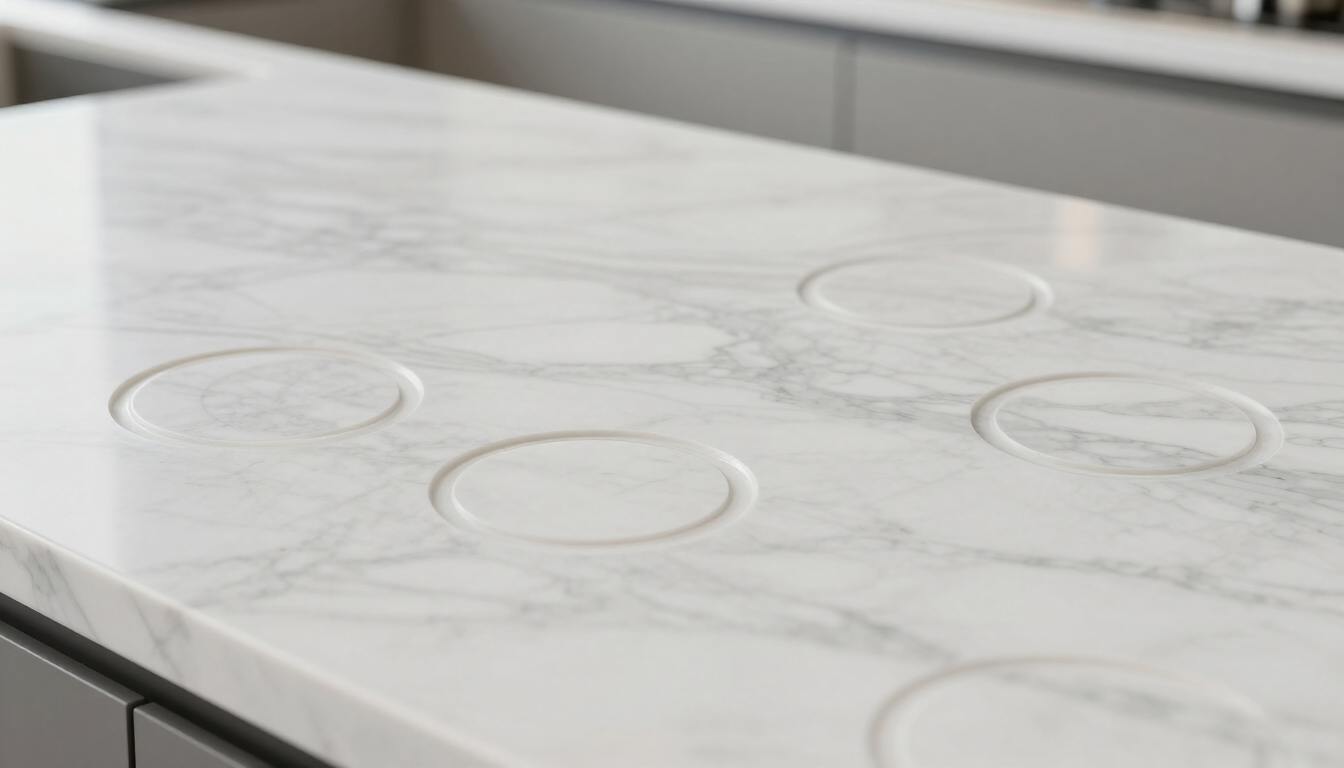
Every ring, every dull patch, every splash mark by the sink is the stone reacting to something acidic. That's not neglect and it's not a defect. It's marble. The good news is that almost all of it is reversible, because the damage is on the surface and the stone underneath is untouched.
What happens to marble
Marble is calcium. Acid reacts with calcium. Lemon, wine, vinegar, tomato, soda, most all-purpose cleaners: each one takes a little polish off wherever it touches. That's an etch. It has no color, it won't wipe off, and sealer never had a say in it, because it happens on the surface, on contact.
Layer normal wear on top of that, especially around the sink, the stove, and the coffee station, and a marble top starts to read as "old." It isn't. It's a surface that's been re-cut by the kitchen, one drop at a time.
Did you know? Sealer doesn't protect marble from etching. It slows down what soaks in. Sealed marble and unsealed marble react to a lemon exactly the same way.
What's fixable
Etching, from one ring to the whole top
All of it. A single light etch is a spot re-polish. A top covered in marks is the whole surface re-honed and re-polished so it matches edge to edge. Either way, the finish comes back because it's rebuilt from the stone, not applied to it.
● Pro: mechanical, in steps
Stains
Most organic and oil stains draw out of marble. What's left after the color is gone is usually an etch under it, since the things that stain marble are often acidic too. We treat both in the same visit.
● Pro: extraction, then re-polish
Chips, scratches, dull edges
Chips fill and blend. Surface scratches come out in the honing steps. Edges that have gone flat from wear re-polish the same way the top does.
● Pro
What isn't fixable is rare on marble: a crack through the slab, or a stain that's had years to travel deep into a light stone. We'll tell you which before anyone shows up.
Did you know? Etches don't spread on their own. A ring you got last year is the same ring today. What grows is the count, and the count is what decides whether it's a spot job or the whole top.
How we restore it
The way the finish was made in the first place. The surface is re-cut with diamond abrasives in steps, coarse to fine, until the etched or worn layer is gone and the reflection is rebuilt evenly. Honed tops are brought back to honed. Polished tops to polished. Then the whole surface is sealed. Nothing is coated. Nothing wears off. What you get back is the stone.
Living with marble after
It will etch again. That's the deal with marble, and the people who love it accept it. What changes is how fast and how much: coasters under anything acidic, a soft cloth and a stone-safe cleaner instead of the spray under the sink, spills blotted instead of left. Do that and the next visit is years out and small.
● Homeowner: coasters, stone-safe cleaner, blot spills, keep acids off it
● Pro: the etch that happens anyway
Did you know? A honed marble finish hides light etching far better than a polished one. If your kitchen is hard on marble, changing the finish is an option, and it's done in the same visit as a restoration.
Send a photo. See it restored.
Your own marble, rings gone, back in your inbox. Plus what we see and what we'd do. No visit, no pressure.